Quality
Discover
Diverse
Fast
Efficient
/
Marumo Exceptional’s focus is more on both public and private sectors. Our core competencies are in technical field such as Telecoms, Mechanical Engineering, Construction, Information Technology, business Management and Projects Management.
Our key objective is to provide high quality constructions at a competitive cost and exceed customer’s expectation. Marumo Exceptional is committed to deliver on time completion of projects, identifying and unearthing new markets throughout the region and nation wide.
Marumo exceptional provides the following integrated construction service amongst others:
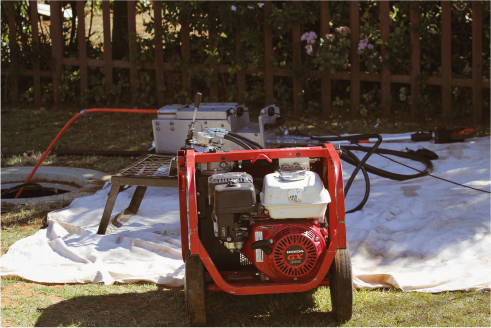
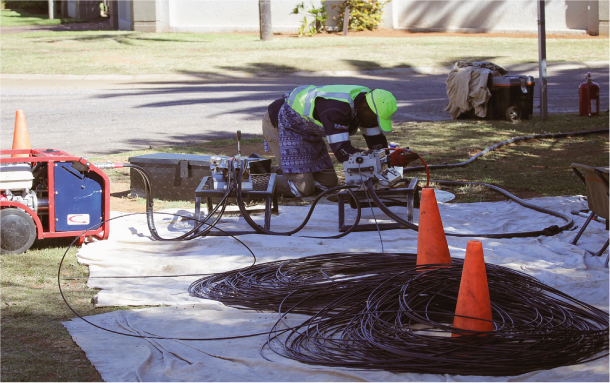
Trenching & laying ducts for Fibre Installation
While at times it can be painful to have this infrastructure installed, the end result will be access to lightning fast Internet. No resident is under any obligation to take out the service or sign up to MTN but we do hope that you will enjoy benefitting from fibre in the longer term. MTN's Fibre To The Home will mean access to service such as Netflix, meaning you can stream movies to you home in real time, an offer Voice Over Internet Protocol (VOIP) meaning you no longer need a landline. It is the nest generation in technology and it will be only available in certain suburbs in South Africa
Outside plant (OSP) installations of fiber optic cables can be much more diverse than premises installations. OSP installs may include installing aerial cable, direct—buried cable, underground cable in conduit or installing conduit or innerduct and then pulling cable, or placing cable underwater. A single link may include several types of installation, for example aerial in one section, pulling in conduit on a bridge crossing and burying the rest of the cable.

.. .Cables may end when pulled into buildings or terminated at the top of poles
Where
surveillance cameras or wireless access points are located splices Where cables
are concatenated can be Placed in Pedestals, buried underground or hung in aerial
splice closures.
The diversity of OSP installation makes it extremely important for the contractor
to know the route of the cable to be installed intimately. Like the estimator who
should walk the route before beginning the estimating process, the contractor needs
to see for themselves the
actual situations they are going to encounter. That inspection allows them to
determine what problems may be encountered, what special equipment may be needed
and even double check that all the permits needed are in order. Long cable pulls in
conduit may
require lubricants or intermediate pulls where your installers need to know how to
“figure
8” cable to prevent kinking, a procedure described later in this chapter.
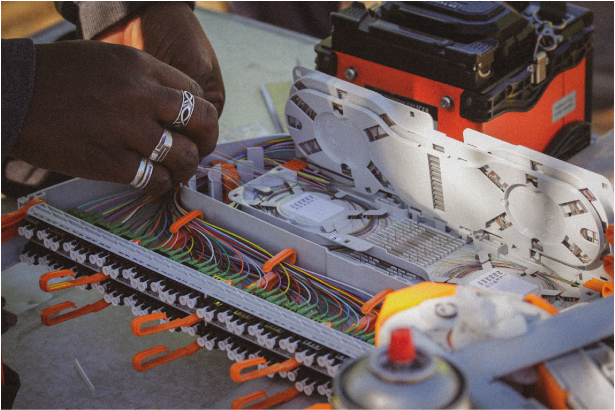
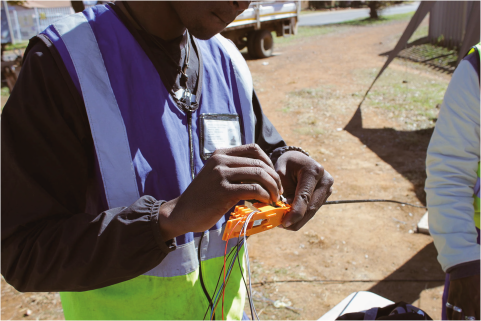
Outside plant splicing is usually done in a special splicing trailer or truck. Inside the truck is a climate-controlled splicing lab with adequate bench space for working with the cables and splice closures. Sometimes, it’s necessary to splice in the open, in a small tent or even in an aerial bucket. The installer has to be able to cope with the conditions found in the installation. In extremely cold conditions, a heated facility will probably be necessary as cables become stiffand equipment hard to operate. Hot climates may be easier on the processes but are equally uncomfortable for the installer.
.. .Ideally splices should be tested with an OTDR as soon as they are made and before placing it in a splice tray. Fusion splicers give an estimate of splice loss, but it’s just an estimate. The OTDR can confirm the quality of the splice, giving the installer an assurance that the splice is good and the splice closure will not have to be reopened to redo a bad splice. Extreme care should be taken when placing splicesin splice trays and arranging buffer tubes or fibers in the closure. One problem that occurs much too often is the fibers are broken as the trays and closure are assembled. Finding breaks in fibers inside the closure is difficult since they are too close to the splice to be resolved by an OTDR. If the splice is near enough to allow tracing with a visual fault locator, it may be found with visual inspection.
Cables must be secured to the splice closure and sealed properly. Generally loose tube cables will have the tubes extending from the entrance of the closure to the tray, where they are secured, then approximately 1 meter of bare fibers are organized in the tray after splicing. Care must be taken to properly bond electrical conductors such as the armor on some cables or center metallic strength members to the closure and at each end. All closures must be sealed to prevent moisture entry. Closures must be properly secured, with the location being determined by the installation type, and excess cable properly coiled and stored. This may be in a pedestal or vault, on a pole or tower or buried underground.

The optical time domain reflectometer (OTDR) uses optical radar-like techniques to create a picture of a fiber in an installed fiber optic cable. The picture, called a signature or trace, contains data on the length of the fiber, loss in fiber segments, connectors, splices and loss caused by stress during installation. OTDRs are used to verify the quality of the installation or for troubleshooting. However, OTDR testing alone shall not be used to determine cable loss.
OTDR testing should only performed by trained personnel, using certified equipment designed for the purpose. The technicians performing the tests should be trained not only in operation of the OTDR equipment, but also in the setup of OTDR test parameters and the interpretation of OTDR traces. OTDRs have limited distance resolution and may show confusing artifacts when testing short cables typical of premises applications. If OTDR testing of premises cables is desired, experienced personnel should evaluate the appropriateness of the tests.